The History of Computing: From Mechanical Dreams to Vintage Computers and the Digital World
Computing did not begin with laptops or smartphones. It began with humanity’s oldest need: to count, measure, predict, and organize information. Over thousands of years, computing evolved from beads on rods to room-sized electronic machines, then to the beloved vintage computers of the 1970s and 1980s, and finally into the networked devices that define modern life.
This is the story of how computing changed the world.
1. The Earliest Computers: Counting Before Electricity
Long before electricity, people created tools to perform calculations.
The Abacus
Used in ancient Mesopotamia, China, Greece, and Rome, the abacus was one of the first practical computing devices. It enabled merchants and officials to add, subtract, multiply, and divide quickly.
Mechanical Calculation
By the 1600s, inventors built machines that automated arithmetic:
- Blaise Pascal created the Pascaline (1642), a mechanical adding machine.
- Gottfried Wilhelm Leibniz improved on this with stepped-drum calculators capable of multiplication.
These devices were the ancestors of modern calculators.
2. The Vision of Programmable Machines
In the 1800s, computing took a conceptual leap.
Charles Babbage and the Analytical Engine
Charles Babbage designed the Analytical Engine, a mechanical machine that included:
- memory
- a processor (“mill”)
- punched-card programming
- conditional logic
It was never fully built, but the design resembled modern computers.
Ada Lovelace: First Programmer
Ada Lovelace wrote notes describing how Babbage’s machine could manipulate symbols—not just numbers. Many historians consider her the first computer programmer.
3. Computing in the 20th Century: War Accelerates Innovation
The early 1900s saw tabulating machines and electromechanical systems.
IBM and Punch Cards
IBM grew from businesses that automated census and accounting tasks using punched cards.
World War II and Codebreaking
War created urgent demand for fast computation.
- Bletchley Park housed British codebreaking efforts.
- Machines such as Colossus helped decipher German encrypted messages.
- Alan Turing laid foundations of theoretical computer science.
4. The First Electronic Computers
ENIAC (1946)
Often considered the first general-purpose electronic computer, ENIAC used thousands of vacuum tubes and occupied a large room. It performed calculations vastly faster than humans. (Wikipedia)
Stored Program Revolution
Later machines stored instructions in memory rather than rewiring hardware manually. This became the dominant architecture of modern computing.
5. Mainframes and the Corporate Age (1950s–1960s)
By the 1950s and 1960s, computers entered governments, universities, and large companies.
Mainframes
These systems:
- filled rooms
- required cooling systems
- cost millions
- served many users via terminals
Companies like IBM dominated the era.
Transistors Replace Vacuum Tubes
The invention of the transistor made computers:
- smaller
- cooler
- faster
- more reliable
This was one of the greatest technological turning points in computing history.
6. The Microprocessor Changes Everything (1970s)
In 1971, Intel introduced the 4004, one of the first commercial microprocessors—a complete CPU on a chip.
This enabled computers small enough for individuals.
7. The Birth of Personal Computing
Altair 8800 (1975)
The Altair 8800 is widely credited with igniting the home computer revolution. It arrived as a kit and used front-panel switches.
It inspired hobbyists—including two young programmers:
- Bill Gates
- Paul Allen
They created an early BASIC interpreter for it.
8. The Golden Age of Vintage Computers (Late 1970s–1980s)
This era is treasured by collectors because machines had distinct personalities, designs, sounds, and communities.
Apple II (1977)
Apple launched the Apple II, one of the first successful mass-market home computers.
It offered:
- color graphics
- expansion slots
- cassette and floppy storage
- approachable design
It became especially important in schools and small businesses.
Commodore PET and Commodore 64
Commodore International released several iconic machines.
Commodore PET
One of the first all-in-one personal computers.
Commodore 64 (1982)
The Commodore 64 became the best-selling single desktop computer model of all time, with estimates between 12.5 and 17 million sold. (Wikipedia)
Why it mattered:
- excellent sound chip (SID)
- colorful graphics
- huge game library
- affordable price
Many people first learned programming through:
10 PRINT “HELLO”
20 GOTO 10
TRS-80
Sold by RadioShack, the TRS-80 brought computing into shopping malls and suburban America.
Atari Home Computers
Atari built the Atari 400 and 800 systems, notable for gaming and multimedia power.
Sinclair ZX Spectrum
In the UK, the ZX Spectrum became legendary for making computing inexpensive and accessible.
9. IBM PC and Standardization (1981)
The IBM PC 5150 changed business computing.
Instead of a closed ecosystem, its architecture was widely cloned. Soon “IBM compatibles” spread worldwide.
This led to:
- MS-DOS dominance
- interchangeable hardware
- the rise of the PC industry
10. Macintosh and the GUI Revolution
In 1984, Apple launched the Macintosh.
It popularized:
- mouse input
- windows and icons
- desktop publishing
- user-friendly design
The graphical user interface changed expectations forever.
11. Why Vintage Computers Still Matter
Collectors and enthusiasts still restore and use vintage systems because they represent a time when computers were understandable and tactile.
Reasons people love them:
Simplicity
Boot directly into BASIC or a command prompt.
Repairability
Chips, sockets, keyboards, and boards can often be repaired.
Character
Each platform had unique:
- startup screens
- sounds
- colors
- keyboard feel
- culture
Historical Importance
They were the bridge between industrial computing and personal creativity.
Reddit communities dedicated to vintage computing remain active, with users sharing restorations, collections, and first-computer memories. (Reddit)
12. From Desktops to the Internet Era
In the 1990s:
- faster processors
- graphical operating systems
- CD-ROM drives
- sound cards
- modems
Then came:
- the web
- laptops
- Wi-Fi
- smartphones
- cloud computing
The computer moved from the desk into the pocket.
13. Today and Tomorrow
Modern devices are millions of times more powerful than early machines. Yet the lineage is clear:
- memory from Babbage’s ideas
- stored programs from postwar pioneers
- personal ownership from 1970s hobbyists
- GUI concepts from 1980s systems
- networking from the internet era
Now computing explores:
- artificial intelligence
- quantum systems
- augmented reality
- autonomous machines
14. Final Reflection
The history of computing is not just a story of machines—it is a story of human ambition. Each generation tried to make thought faster, information easier to handle, and creativity more accessible.
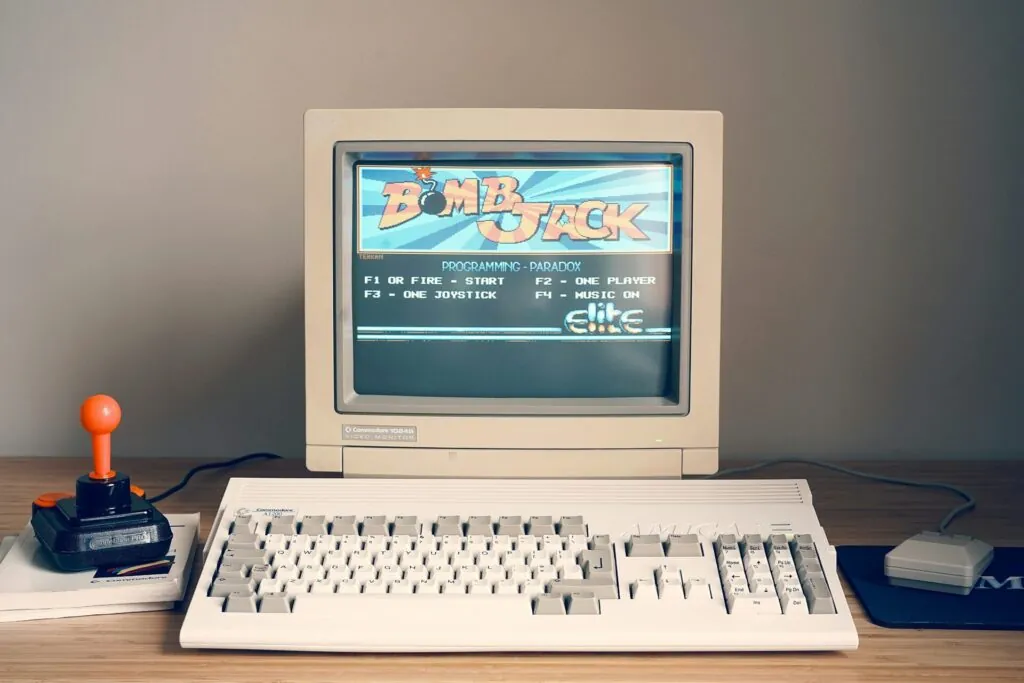
Vintage computers remind us that progress once came in beige plastic boxes, glowing CRT screens, clicking floppy drives, and lines of BASIC code typed by curious beginners.
Modern computing stands on their shoulders.
Suggested Vintage Computers Worth Exploring
- Apple II
- Commodore 64
- IBM PC 5150
- TRS-80
- ZX Spectrum
- Atari 800
- Macintosh